Book Review: How Big Things Get Done – Learning from History and Data – Part1
Book Review: How Big Things Get Done – Learning from History and Data
Understanding the past to pave the way for future project success.
The Power of Historical Data in Project Success
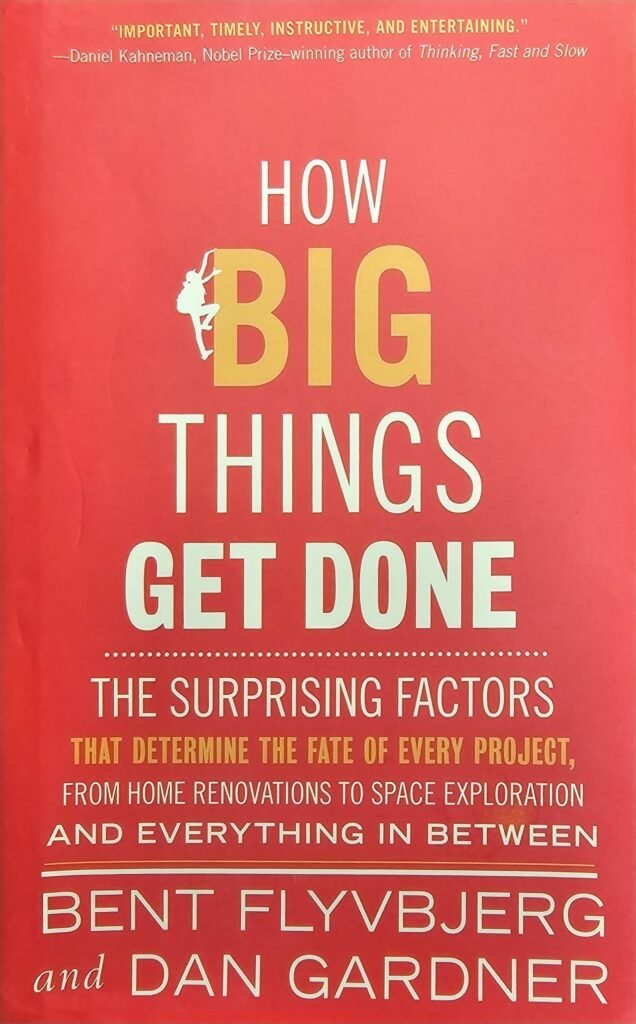
Understanding history is crucial for achieving success in the future, particularly when accompanied by comprehensive data analysis. This concept is effectively conveyed in the book “How Big Things Get Done” authored by Prof. Bent Flyvbjerg and Dan Gardner. The book offers valuable insights based on years of experience and delves into the analysis of project data spanning decades after delivery, which provides the full story of the project’s real benefits and outcomes.
Upon reading the book, I found it to be rich with actual examples, studies, and feedback. The comprehensive case studies of projects’ success and failure provide invaluable insights to learn from.
The approach of storytelling, rather than a rigid academic or engineering analysis, allows for easy, insightful, and understandable language about the project’s history. From the initial vision to build a unique and unforgettable structure, to the point of realizing success or failure, the book offers a deep dive into the untold thoughts and hidden facts behind the projects. Prof. Flyvbjerg utilized both the data history and input from project members to provide a comprehensive understanding of the projects, which adds significant value to rigid project data.
Beyond the Numbers: A Unique Perspective on Project Performance
Moreover, what differentiates this book from other academic research on budget overrun and time delays is that it avoids abusing the terms “over budget” and “time delays” without explaining the project type and the circumstances the project went through. It provides detailed percentages of overrun and delays by project type, covering approximately 25 types of projects, from buildings and power to rail and more.
The only comment I have here is to add the dimension of whether a project is public-funded, private-funded, or a joint investment between private and public entities. I believe the high percentage of budget overrun might be less for the private sector because they typically have better governance around the business case of cost and profit analysis in their gate reviews. Perhaps in future revisions, the project data table will be expanded for more insights.
The authors take us on a guided tour through a rich history of case studies, exploring how a vision to deliver an amazing project—to serve a nation or leave an unforgettable impression on visitors and end-users—can ultimately end in shameful failure or the joy of success. This type of data and case study analysis is highly sought after by engineering and construction professionals, including myself. I had the feeling that this book would align my own experiences on various aspects of project delivery, which it did. The similarity between Middle East experience and international projects data is striking, a topic for another article. Any Engineering and Construction professional, especially in public sectors and private developers, would recognize the value of using and understanding such data to plan future projects more wisely. Moreover, the fact that the book is written by an academic professor and practicing planning specialist with extensive experience in project economy, planning, and project controls adds a lot to its credibility.
Case Study: California High-Speed Rail – A Soaring Vision Meets Soaring Costs
While reading “How Big Things Get Done,” I found myself delving deeper into the cases presented in the book. I took the initiative to search for more information about their history outside of the book and its endnotes, drawing insights from different resources. My aim was to gain a different perspective and identify patterns of success and failure, comparing these international experiences with those in the Middle East.
The book explores various projects starting from the initiation stage, where someone conceives an idea or vision for a challenging project. Through simple storytelling, the author explains how such visions can be transformed into either successful or failed projects. One of the visionary projects studied in the book is the California High-Speed Rail, an ambitious plan to link downtown Los Angeles to downtown San Francisco in just two and a half hours. This goal is impressive, and the project promises to serve millions every year, reduce emissions and cost, utilize the latest safest speed rail technology, and provide an exceptional traveler experience.
Initial Vision & Promise (2008)
Planned cost: $33 billion. Opening by 2020. Ticket price: $68 to $104. Promised to serve millions, reduce emissions, and use latest safe technology.
Cost Escalation (As per book)
“Cost estimates soared, to $43 billion, $68 billion, $77 billion, then almost $83 billion. As I write, the current highest estimate is $100 billion. But the truth is that nobody knows what the full, final cost will be.”
Latest Developments (Post-Book Research)
Scheduled to continue, with a delivery date of 2030 and a three-year risk of delays to 2033 for the Entire Phase 1 System (San Francisco to Anaheim). Feb 2022 draft business plan estimated up to $105 billion; less than three months later, “final plan” raised it to $113 billion. Current website estimate: $88 billion to $128 billion.
Staggering Cost Impact
The cost overruns are mind-blowing, jumping from $33 billion to a staggering $128 billion. This latter budget is roughly 40% of Saudi Arabia’s 2023 budget and could cover California’s entire $84.2 billion deferred maintenance budget (2022).
This raises the hard question again: why do we continue such huge budget projects? The book discusses many similar projects with such massive budget overruns. It opens the mind of the public to ask why it happened, and why we could not deliver it within budget or with a responsible increase.
Case Study: Monju Nuclear Project – The Cost of Unfulfilled Ambition
The book also highlights a total failure: the mega nuclear power project known as Monju (meaning “wisdom” in Japanese), which spent $12 billion and was expected to spend another $3.4 billion for decommissioning, generating zero electricity.
Monju Nuclear Project: Key Facts
Initiated in 1983, the Japanese government aimed to generate a 280-megawatt (MW) reactor designed to burn plutonium refined from spent conventional reactor fuel while simultaneously creating more fuel. This process was considered most promising for a country with limited natural resources. However, in 2017, authorities admitted failure and requested approval to decommission the plant, resulting in $12 billion spent for zero electricity, with an additional $3.4 billion for decommissioning.
The book sheds light on various reasons for cost overruns and project delays, but the root cause is often the lack of proper planning and research before undertaking a project. The author emphasizes the importance of having a dream, but also stresses that planning and data analysis are crucial in providing credible information to decision-makers.
The staggering cost of the California High-Speed Rail project, estimated at $128 billion, raises questions about whether this money could have been better spent on more critical projects like the old infrastructure, which needs urgent funds.
The book also highlights the role of politicians in the project’s challenges, with the initial budget of $33 billion being significantly lower than the expected costs. This reflects poor management and decision-making in a democratic country where opposing views and opinions should be considered. The opposition to the project, fueled by unclear cost estimates, contributed to significant delays. Ultimately, a referendum was necessary to secure public support for the project, despite the enormous budget.
Lessons from History: Navigating Visionary Projects
What can we learn from the history of ambitious projects provided in the book? How can we apply this knowledge to our future planning?
It’s clear that we can’t stop dreaming big, and the book provides insight into the challenges and costs associated with such visionary projects. Take the Sydney Opera House, for example, which took 14 years to complete and was significantly over budget. If people had known the cost upfront, they may not have supported the project, but now it stands as an iconic symbol of Australia.
Similarly, the International Space Station and the James Webb Telescope were both significantly over budget, but the benefits of these projects are immeasurable. We’ve gained a better understanding of space and the universe, which is priceless.
Therefore, it’s important to note that not all projects with delays and budget overruns are considered a failure. Public and stakeholder opinions, as well as the magnitude of time and budget variation, must be taken into consideration.
The book features many case studies that illustrate the success pattern too. One standout example of a successful project is Heathrow Terminal 5, which was covered in the previous part of this review.
If you haven’t read the book, I highly recommend it. I can’t expand more in this article, which is already quite lengthy. It includes more interesting case studies.
Thanks a lot for the valuable effort of the authors. I raise my hat for both of them.
Written by Ziad Albasir